Sunday, February 7, 2010

The Church of England has disinvested from the controversial mining company, Vedanta Resources

The Church of England has disinvested from the controversial mining company, Vedanta Resources, after sustained pressure from campaigners, including many Christian groups.

The Church Commissioners and the Church of England Pensions Board announced today (5 February) that they have sold their shares in the mining company on the advice of the Church’s Ethical Investment Advisory Group (EIAG).

As a result, none of the three national investing bodies of the Church of England now hold shares in the company.

FULL STORY

Wednesday, February 3, 2010

Tribals non-entities in their own jatara

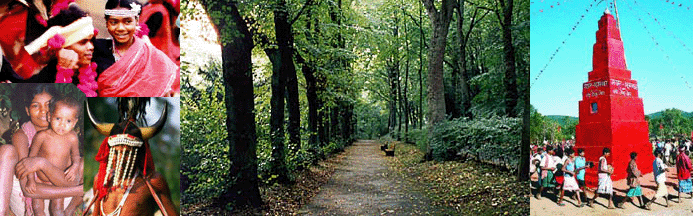
Though the jatara has gained prominence in the last 20 years, ironically a mere 5-10 per cent of tribals take part in the festival. “This reflects the suppression of tribals by non-tribals which has been the case since the time of Kakatiya dynasty,’’ asserts historian V L Narasimha Rao. In this jatara, which ended on Saturday, only five lakh tribals attended (the crowd rush swelled to 90 lakhs this time around).

While the government goes to town about the cultural significance of the jatara, the increasing numbers of non-tribals, politicians, actors and techies turning up for the fair does not bode well, opine professors and experts. “It has become a ‘jalsa jatara.’ It’s appalling that no effort is being made to protect age-old customs, culture and art forms of the Girijans,’’ says Prof A Seetaram Naik of Kakatiya University.

FULL STORY

Thursday, January 28, 2010

‘Avatar is real’, say tribal people


Following the film ‘Avatar’’s win at the Golden Globes, tribal people have claimed that the film tells the real story of their lives today.

A Penan man from Sarawak, in the Malaysian part of Borneo, told Survival, ‘The Penan people cannot live without the rainforest. The forest looks after us, and we look after it. We understand the plants and the animals because we have lived here for many, many years, since the time of our ancestors.

FULL STORY


Monday, January 25, 2010

Channel 4 investigates Bastar..........

While India's own media does not care about it's own people, it is heartening to see that Channel 4 spent a month to bring out this report. The footage is disturbing if you are a sensitive person. But that is what is happening in the beautiful state of Chhattisgarh.


FULL STORY

Friday, January 8, 2010

Silencing tribal voices

Operation Green Hunt is finally put into full gear; the Union home minister is asked to stay away from its area of operation; and a Gandhian begins a hunger strike at its centre. What do these recent developments imply?

First, the harsh truth — the Centre’s, and consequently the media’s, near-silence all through the last month on its heavily tom-tommed proposed armed offensive against the Maoists, was no rethink. The war cries had boomeranged; it made more sense to keep quiet, let the protests fizzle out, and go ahead with it. It was foolish anyway, to have thought that the outrage of intellectuals (and a few retired security men) could outweigh the exciting prospect of big business finally moving in on all those riches buried under the Dandakaranya forests. As planned, the moment the Jharkhand elections got over, the offensive began. But why is the Union home minister, the man behind it, being asked to stay away? That too by the governor of the State at its epicentre?

FULL STORY

Monday, January 4, 2010

'Public sector created Chhattisgarh's middle class'

What news of the offensive?
When Operation Green Hunt began in September, notice under Section 95 of the CrPC (which includes sedition) was served on newspapers for publishing the Maoists' press releases, which said that the only persons to have been killed by the security forces were ordinary Adivasis. Over 100 journalists demonstrated in Jagdalpur saying that in a conflict situation, we can't print only police handouts. Journalists have been arrested under the State's Special Security Act. For us, this new offensive is only an intensification of the drive going on since 2005, to clear villages to facilitate a corporate land grab, in the name of fighting insurgency.

FULL INTERVIEW

India's Poverty Line Is Actually A Starvation Line

There is something terribly wrong with growth economics. After all, 18 years after India ushered in economic liberalisation, the promise of high growth to reduce poverty and hunger, has not worked. In fact, it has gone the other way around: the more the economic growth, the higher is the resulting poverty.

A report by an expert group headed by Suresh Tendulkar, formerly chairman of Prime Minister’s Economic Advisory Council, now estimates poverty at 37.2 per cent, an increase of roughly 10 per cent over the earlier estimates of 27.5 per cent in 2004-05. This means, an additional 110 million people have slipped below the poverty line in just four years.

FULL STORY